If perimenopause insomnia has you waking up every night at 3 a.m., you are not imagining it.
Many women who never had serious sleep problems suddenly start waking several times a night, lying awake after hot flashes, or feeling exhausted even after spending enough time in bed.
Hot flashes and night sweats matter. Hormonal change can absolutely trigger sleep disruption. But modern sleep medicine adds a second part to the story: the trigger that starts insomnia is not always the same thing that keeps insomnia going.
That distinction is why Cognitive Behavioral Therapy for Insomnia (CBT-I) is recommended as the first-line treatment for chronic insomnia in adults, and why menopause-adapted CBT-I is being studied specifically for women with nighttime hot flashes.
Why perimenopause can disrupt sleep
During perimenopause, estrogen and progesterone can fluctuate sharply. For some women, those shifts are linked with:
- night sweats
- hot flashes
- frequent awakenings
- lighter sleep
- increased anxiety
- mood changes
At first, the cause can feel obvious. A hot flash wakes you up. A night sweat interrupts the night. You cool down, change position, or adjust the covers.
The difficult part is what happens next.
When insomnia becomes independent of hormones
Imagine waking at 2:30 a.m. because of a hot flash. A few minutes later, the heat passes.
But your mind is already active:
Why am I awake again?
Tomorrow is going to be awful.
I need to fall asleep right now.
Many women then spend more time in bed trying to recover sleep, check the clock, nap the next day, sleep in on weekends, or start treating bedtime as a nightly test.
Those reactions are understandable. They are also exactly the patterns that can maintain chronic insomnia. Over time, the brain can learn that bed is a place for effort, monitoring, frustration, and wakefulness.
The original trigger may have been hormonal. The ongoing insomnia may now be held in place by learned sleep behaviors and anxious thoughts around sleep.
What CBT-I changes
CBT-I does not force sleep, and it does not treat menopause itself. It targets the behavioral and cognitive loop that keeps insomnia alive after the first trigger.
The core tools are practical:
Sleep diary
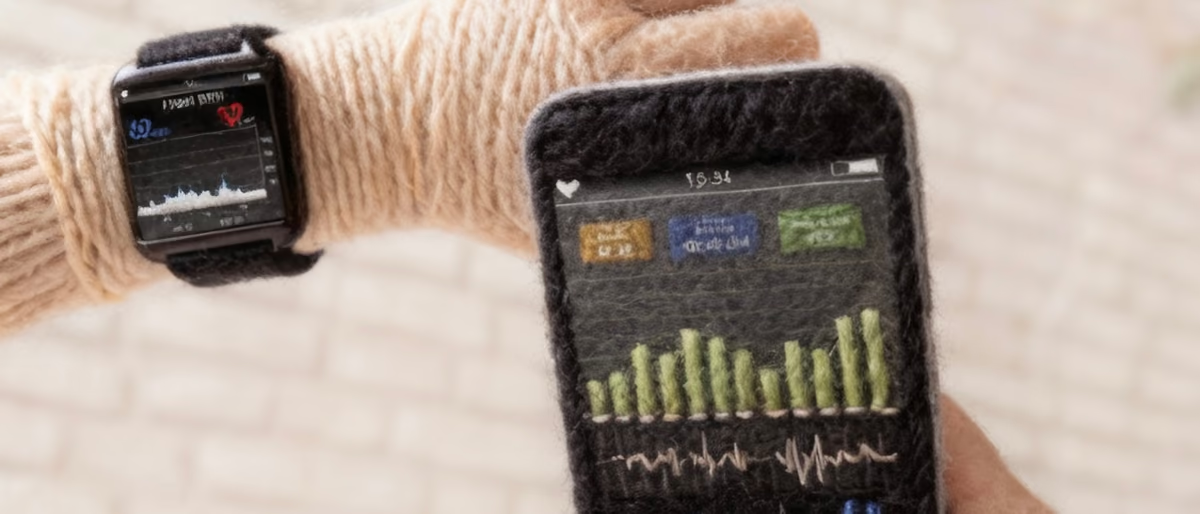
Each morning, you record bedtime, estimated time to fall asleep, awakenings, final wake-up time, and time out of bed. This turns a confusing night into usable data.
Sleep efficiency
CBT-I looks at how much of your time in bed was actually spent asleep. Better sleep efficiency is often a sign that sleep is becoming more consolidated.
Stimulus control
If the bed has become linked with wakefulness, stimulus control rebuilds the association between bed and sleep.
Sleep restriction
Sleep restriction sounds counterintuitive, but the goal is not to sleep less forever. It temporarily narrows time in bed to increase sleep pressure and reduce long stretches of lying awake.
Cognitive therapy
CBT-I also works with thoughts like:
- "I'll never sleep normally again."
- "My hormones have ruined my sleep."
- "If I don't get eight hours tonight, tomorrow will be a disaster."
The goal is not forced positive thinking. The goal is to reduce sleep-related threat and help the body return to sleep more easily after awakenings.
Pros and limits of CBT-I for perimenopause insomnia
Pros: CBT-I targets sleep effort, clock-checking, irregular time in bed, and conditioned arousal after nighttime awakenings. It also gives you measurable tools, such as a sleep diary and sleep efficiency, instead of relying on memory after a difficult night.
Limits: CBT-I does not stop hot flashes or replace menopause care. It also takes consistent practice, and new, severe, or unexplained symptoms still need medical assessment.

Your Personal Sleep Coach
AI-powered insights and personalized guidance for better sleep

CBT-I has been adapted for menopausal insomnia
Researchers have also adapted CBT-I for women whose insomnia is tied to hot flashes and night sweats. One version is called CBT for Menopausal Insomnia (CBT-MI).
CBT-MI builds on standard CBT-I. It keeps the sleep diary, sleep efficiency work, stimulus control, sleep restriction, and cognitive therapy. It also helps women understand how nighttime vasomotor symptoms interact with insomnia.
The goal is not to eliminate hot flashes. The goal is to prevent a temporary hormonal awakening from turning into two hours of worry, effort, clock-checking, and conditioned arousal.
What the research shows
A randomized controlled pilot trial published in Menopause studied 43 perimenopausal and postmenopausal women with insomnia and nighttime hot flashes. Participants received either CBT-MI or menopause education.
Compared with education alone, CBT-MI was associated with larger short-term improvements in insomnia severity, sleep self-efficacy, and hot-flash interference. The researchers also noted that some benefits declined by the three-month follow-up, suggesting that ongoing practice or booster support may matter.
That nuance is important. CBT-I is not a magic switch. But the study supports a clinically useful point: even when menopausal symptoms continue, insomnia can improve when the behaviors and thoughts maintaining it are addressed.
What about hormone therapy?
That leaves the question most women in perimenopause are actually weighing. Hormone therapy (HT) is the most effective treatment there is for moderate to severe vasomotor symptoms — and when those nighttime surges are what keep waking you, treating them can meaningfully improve sleep.
The regulatory picture in the United States changed recently. In November 2025, the FDA moved to remove the broad boxed warning about cardiovascular disease, breast cancer, and probable dementia from systemic hormone therapy labels, and the first revised labels were approved in February 2026. Two things are worth understanding about that change. First, it did not erase the underlying risk information: contraindications and study findings remain in the prescribing information — what changed is the prominent class-wide warning, replaced with more age- and product-specific guidance. Second, one boxed warning stayed: systemic estrogen taken alone still carries the endometrial-cancer warning for women with a uterus, which is why a progestogen is usually added.
Professional guidance has been consistent on who tends to benefit: for healthy women under 60, or within about 10 years of menopause onset, with bothersome vasomotor symptoms, the benefits of hormone therapy generally outweigh the risks. A history of breast cancer, blood clots, stroke, heart attack, or liver disease points the other way. That decision is individual, and it belongs in a conversation with your clinician.
For sleep specifically, the key nuance is this: hormone therapy improves sleep mainly by reducing the night sweats and hot flashes that wake you. If your insomnia continues even on nights without hot flashes — the learned pattern described above — HT is not a stand-alone insomnia treatment, and that is exactly the gap CBT-I is designed to fill. The two are not rivals: one treats the trigger, the other treats the loop, and some women benefit from both.
When CBT-I is not enough on its own
CBT-I is a strong behavioral approach for chronic insomnia, but it is not the right answer to every nighttime problem.
Talk with a clinician if insomnia is new, severe, or rapidly worsening; if night sweats are heavy or unexplained; if mood symptoms are significant; if you snore, gasp, or suspect sleep apnea; or if you are considering hormone therapy, stopping medication, or changing a prescription.
That threshold matters. CBT-I can reduce the learned insomnia cycle after an awakening. It should not be used to ignore a medical symptom that needs assessment.
Why sleep diaries matter so much
A sleep diary is one of the simplest CBT-I tools, but it is also one of the most useful.
It helps you track:
- bedtime
- sleep onset
- awakenings
- total sleep time
- sleep efficiency
Instead of guessing whether the night is improving, you can see patterns over time. That data makes sleep-window adjustments more personalized and helps separate one bad night from a real trend.
Zomni uses sleep diary entries and CBT-I-informed tracking to help you understand your sleep pattern and practice evidence-based sleep skills on your iPhone. It is not a substitute for medical care, hormone therapy advice, or a licensed CBT-I provider, but it can support the daily work that CBT-I depends on.
The bottom line
Perimenopause insomnia is real. Hormonal changes can disrupt sleep, and hot flashes can wake you up.
But chronic insomnia often continues because the brain learns to expect wakefulness and danger at night. That learned cycle can be changed.
CBT-I does not fight your hormones. It helps retrain the sleep behaviors and thoughts that keep the night stuck.
Frequently Asked Questions
Can CBT-I help if hot flashes wake me up?
Is perimenopause insomnia different from regular insomnia?
Do I still need to talk to a clinician?
Your Personal Sleep Coach
AI-powered insights and personalized guidance for better sleep
References
- Arentson-Lantz EJ, et al. Cognitive behavioral therapy for menopausal insomnia in perimenopausal and postmenopausal women with insomnia and nocturnal hot flashes: a randomized-controlled pilot trial. Menopause. 2026. PubMed
- MGH Center for Women's Mental Health. CBT for Menopause: Improving Sleep and Hot Flashes Without Medication. 2026. Article
- American College of Physicians. ACP Recommends Cognitive Behavioral Therapy as Initial Treatment for Chronic Insomnia. 2016. ACP
- Furukawa Y, et al. Components and Delivery Formats of Cognitive Behavioral Therapy for Chronic Insomnia in Adults: A Systematic Review and Component Network Meta-analysis. JAMA Psychiatry. 2024. 10.1001/jamapsychiatry.2023.5060
Medical advice disclaimer
This article is for informational and educational purposes only. It is not medical advice, diagnosis, or treatment. Always talk with your physician, gynecologist, or sleep specialist about new or worsening insomnia, night sweats, hormone therapy, medication changes, or possible sleep disorders.