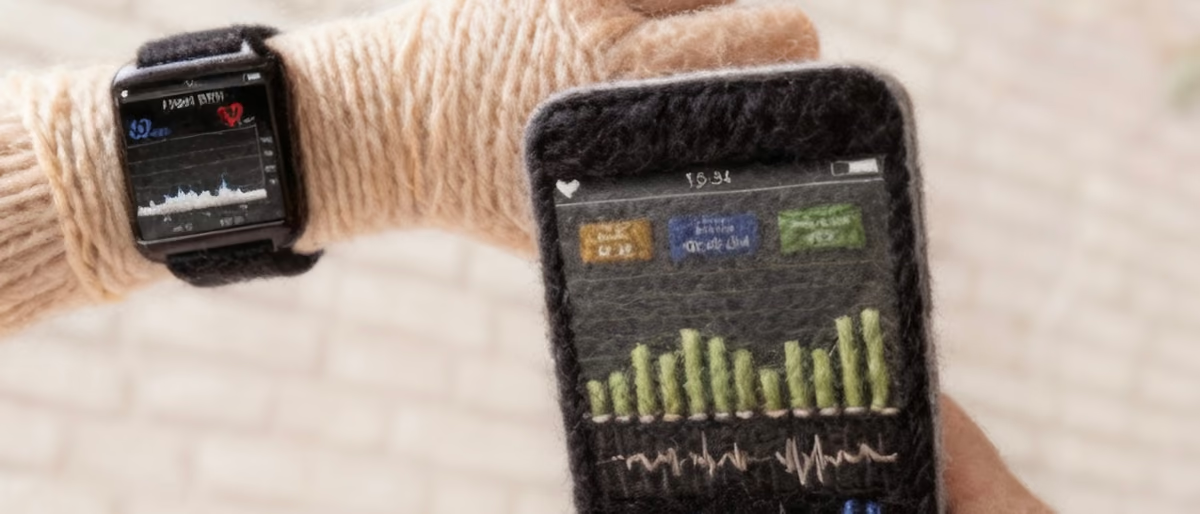
Can you trust your sleep score?
Your watch says you got 12% deep sleep. Your ring disagrees. An app that only listened to you breathe claims you woke up four times. Who's right?
For once, there's a proper answer. In 2023, a team of sleep researchers in South Korea put 11 consumer sleep trackers through the one test that settles arguments: a night in the sleep lab, wired up to polysomnography — the medical gold standard that reads brain waves, eye movements and muscle tone, scoring sleep in standard 30-second epochs. The results were published in the peer-reviewed journal JMIR mHealth and uHealth, and they are far more interesting than any marketing page.
Some devices did remarkably well. Some did barely better than guessing. And the single most accurate sleep-stager in the lineup wasn't a $400 wearable — it was a smartphone app that never touches your body.
How the study worked
The researchers enrolled 75 adults across two hospital sleep centers. Each participant spent a night under full polysomnography while a set of consumer trackers recorded the same night. Because nobody can wear eleven gadgets at once, participants were split into two groups of 37 and 38, each carrying 8 of the 11 devices — so every tracker was validated on part of the sample (from 22 to 75 people per device), not on all 75.
The 11 trackers fell into three families:
- Wearables: Apple Watch 8, Galaxy Watch 5, Google Pixel Watch, Fitbit Sense 2, Oura Ring 3
- Nearables (devices near the bed): Amazon Halo Rise, Google Nest Hub 2, Withings Sleep Mat
- Airables (pure smartphone apps): Pillow, SleepScore, SleepRoutine
Every device's sleep-stage output was compared epoch by epoch against the lab's scoring. The headline metric, macro F1, summarizes how well a tracker identifies all four states — wake, light, deep and REM — where 1.0 would be a perfect match.
The results: which sleep tracker is most accurate?
| Device | Type | Sleep-stage accuracy (macro F1 / agreement band) |
|---|---|---|
| SleepRoutine | App | 0.6863 |
| Amazon Halo Rise | Nearable | 0.6242 |
| Google Pixel Watch | Wearable | moderate agreement |
| Galaxy Watch 5 | Wearable | moderate agreement |
| Fitbit Sense 2 | Wearable | moderate agreement |
| Apple Watch 8 | Wearable | fair agreement |
| Oura Ring 3 | Wearable | fair agreement |
| Withings Sleep Mat | Nearable | fair agreement |
| SleepScore | App | fair agreement |
| Google Nest Hub 2 | Nearable | slight agreement |
| Pillow | App | 0.2588 |
The spread is enormous: from 0.6863 at the top to 0.2588 at the bottom of the same test. On the agreement scale statisticians use (Cohen's κ), five devices reached "moderate" agreement with the lab — Google Pixel Watch, Galaxy Watch 5, Fitbit Sense 2, Amazon Halo Rise and SleepRoutine — while Apple Watch 8, Oura Ring 3, the Withings mat and SleepScore managed only "fair" agreement, and Google Nest Hub 2 and Pillow trailed with "slight" agreement.
Two stage-level records worth knowing: Google Pixel Watch was the best of the top devices at spotting deep sleep (F1 0.5922), and SleepRoutine led both REM detection (0.7596) and wake detection (0.7065).
How accurate is Apple Watch sleep tracking?
This is the question people actually search — so here is the honest answer from the data. In this study, Apple Watch 8 landed in the "fair agreement" band for sleep staging: useful, but a clear step below the moderate-agreement group.
Its characteristic error is one it shares with most wrist devices. In the authors' words: "Wearables primarily misclassified wake as light, while nearables strongly misclassified REM as light." Translated: when you lie awake at 3 a.m., perfectly still and frustrated, your watch is likely to log that time as light sleep. The number you care about most if you sleep badly — time awake at night — is precisely the one wearables blur.
Oura Ring, Fitbit and the other wearables
- Oura Ring 3 — also "fair" agreement on sleep staging in this study. A well-built ring, but its stage labels disagreed with the lab more often than the moderate group.
- Fitbit Sense 2 and Galaxy Watch 5 — both reached "moderate" agreement, the best band any wearable achieved here.
- Google Pixel Watch — moderate agreement overall and the strongest deep-sleep detection among the leading devices.
If you own one of these, the practical reading is the same: total sleep time is the most dependable number; exact stage percentages and wake episodes deserve healthy skepticism. (Whether night-to-night trends hold up is a fair question this one-night study simply cannot answer.)
The surprise winner: an app with no hardware at all
SleepRoutine — a smartphone app from the Korean company Asleep that analyzes your breathing sounds from the nightstand — posted the highest sleep-staging accuracy of all 11 devices, beating every watch and ring in the lineup.
That deserves genuine credit, and also honest context. This study was not independent of the winner: the paper discloses that "authors affiliated with Asleep and CAK hold stocks or stock options in Asleep," and SleepRoutine's algorithm was trained on data from one of the very hospitals where the validation ran. The authors also state the companies "played no role in study design, data collection, analysis and interpretation of data, or writing of this manuscript." Both things can be true — the methodology is public and peer-reviewed — but a reader should know who conducted the study and who built the winning technology.
The fine print most reviews skip
Before you replace your gadget, four limitations matter:
- Even the best tracker reached only "moderate" agreement with polysomnography. No consumer device in this study earned the "substantial" or "near-perfect" bands. The authors frame trackers as promising for everyday sleep monitoring — not as diagnostic tools for sleep disorders.
- All 75 participants were Korean adults sleeping one night in a lab. How these devices perform on your mattress, your bed partner's snoring and your dog is untested here.
- Per-device sample sizes varied widely — from 22 people on Galaxy Watch 5 to 75 on the Withings mat — and the two hospital sites collected data at different rates.
- Algorithms move fast. These results reflect 2023 firmware and models; today's versions may score differently — in either direction.
When tracking becomes the problem
There's a stranger risk the study can't measure: what the data does to you. Sleep researchers led by Kelly Baron described it back in 2017 and coined a name for it — orthosomnia, a pattern seen in their case reports where the pursuit of perfect sleep-tracker numbers went hand in hand with worse sleep. Patients lay awake worrying about their scores, and some trusted the gadget over their own body. We walk through one such case, step by step, in our guide to orthosomnia and how a sleep clinic undoes it.
"The morning graph never once got me to sleep earlier," says Maksim, Zomni's co-founder. "A rule I actually followed that evening did."
If your tracker motivates you, keep it. If checking your sleep score has become one more reason to feel anxious in bed, a reasonable experiment is a few nights off from the data.
Measuring sleep vs changing it
Here is the boundary this entire comparison rests on: a tracker tells you what happened; it doesn't change what happens tonight. For chronic insomnia, clinical guidelines — the American College of Physicians (2016) and the American Academy of Sleep Medicine (2021) — recommend cognitive behavioral therapy for insomnia (CBT-I) as the first-line treatment: a structured method of sleep-window adjustment, stimulus control and cognitive techniques.
That's a statement about the method, so let's be precise about the apps. SleepRoutine measures sleep, and this study suggests it does that unusually well. Zomni is a structured self-guided program based on CBT-I principles — a different category of tool. Zomni was not part of this study, has not been evaluated by those guidelines, and does not diagnose or treat any condition. One tool answers "how did I sleep?"; the other works on "what do I do about it?"
Sleep Routine
Sleep tracking & smart alarm

Zomni
CBT-I-based sleep program
| Sleep Routine | Zomni | |
|---|---|---|
| Built to | Measure your sleep | Change sleep habits |
| Method | Audio-based sleep staging | Structured program based on CBT-I principles |
| In the 2023 lab study | Most accurate of 11 trackers | Not evaluated — different category |
| Each morning you get | Sleep-stage graphs | A concrete plan for tonight |
| Needs a wearable | No | No |
| Languages | 3 (English, Japanese, Korean) | 33 |

Zomni is our own app — made by the publisher of this site. Sleep Routine figures come from the 2023 JMIR study and its public App Store listing; we don't link to competitor stores.
The two aren't enemies, and for some people they're not even alternatives: you can measure with one and work on your habits with the other. But if you only fix one thing this month and your problem is falling or staying asleep, the guidelines point at the method itself — CBT-I, as studied in clinical programs — not at a more accurate graph.
FAQ
What is the most accurate sleep tracker?
In a 2023 head-to-head lab validation of 11 consumer devices, the SleepRoutine app scored the highest sleep-staging accuracy (macro F1 0.6863), ahead of Amazon Halo Rise and every watch and ring tested. Note the study's disclosed ties to the winning app's maker.
Is Apple Watch sleep tracking accurate enough to rely on?
For total sleep time, it's serviceable. For sleep stages, Apple Watch 8 reached only "fair" agreement with the sleep lab in this study, and like most wearables it tended to record quiet wakefulness as light sleep.
Can a phone app really track sleep without a wearable?
Yes — that's the study's most surprising result. An audio-analysis app with no hardware outperformed every wearable at sleep staging. Microphone-based breathing analysis has real science behind it, with the usual caveats about labs, samples and versions.
Do sleep trackers help with insomnia?
They document it; they don't treat it. Guidelines recommend CBT-I as the first-line approach for chronic insomnia, and case reports since 2017 have linked over-focusing on tracker data (orthosomnia) with worse sleep in some people. If poor sleep is a persistent problem, talk to a clinician.
Medical disclaimer: This article is for informational and educational purposes only and is not medical advice. Zomni is a wellness application and is not intended to diagnose, treat, cure, or prevent any disease. Ask a physician or another qualified healthcare professional about persistent sleep problems.
References
- Lee, T., et al. (2023). Accuracy of 11 Wearable, Nearable, and Airable Consumer Sleep Trackers: Prospective Multicenter Validation Study. JMIR mHealth and uHealth. DOI: 10.2196/50983
- Qaseem, A., et al. (2016). Management of Chronic Insomnia Disorder in Adults: A Clinical Practice Guideline From the American College of Physicians. Annals of Internal Medicine. DOI: 10.7326/M15-2175
- Edinger, J. D., et al. (2021). Behavioral and psychological treatments for chronic insomnia disorder in adults: an American Academy of Sleep Medicine clinical practice guideline. Journal of Clinical Sleep Medicine. DOI: 10.5664/jcsm.8986
- Baron, K. G., et al. (2017). Orthosomnia: Are Some Patients Taking the Quantified Self Too Far? Journal of Clinical Sleep Medicine. DOI: 10.5664/jcsm.6472

Your Personal Sleep Coach
AI-powered insights and personalized guidance for better sleep