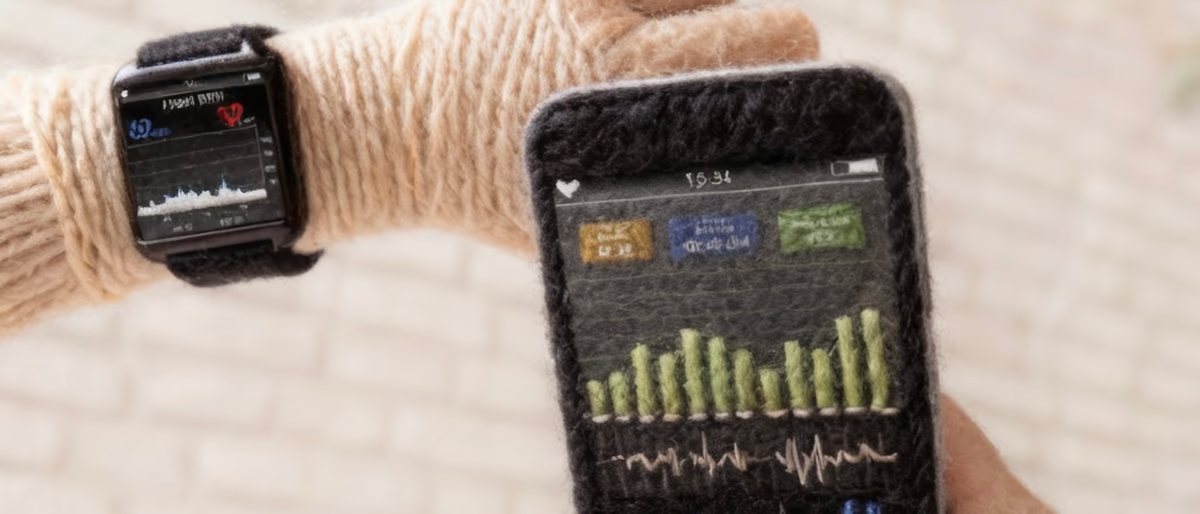
CBT-I vs. Sleep Apps: Why Your "Tracker" Isn't Fixing Your Insomnia in 2026
By 2026, a large share of adults in developed nations wear some form of biometric sleep tracker. Rings, watches, mattress sensors — pick your poison. We've never had more data about our sleep. And yet? Insomnia rates keep climbing. That disconnect should tell you something.
"I see this in my own work constantly," says Maksim, co-founder of Zomni. "People come in with months of 'sleep scores' and graphs — REM cycles, deep sleep percentages, the whole dashboard. They're frustrated. They know exactly how poorly they slept. But knowing didn't fix anything."
That gap — between data and recovery — is the whole story. It's the difference between passive sleep tracking and active clinical therapy like CBT-I. If you're tired of watching your sleep score sink without a plan to raise it, keep reading. Your tracker might actually be part of the problem.
The "Orthosomnia" Trap: When Tracking Becomes a Stressor
There's actually a clinical term for the anxiety caused by sleep trackers, coined by researchers back in 2017: Orthosomnia (Baron et al., Journal of Clinical Sleep Medicine, DOI: 10.5664/jcsm.6472). Maksim, Zomni's co-founder, puts it this way: "I went through this myself — checking my score first thing every morning, feeling my chest tighten when it said 'Poor Sleep.'" For many chronic insomniacs, that morning check triggers a real physiological stress response. Your brain immediately starts spiraling: How am I going to get through today? And that worry? It makes tomorrow night worse. A vicious loop that no sleep score can break. How that loop starts, and how a sleep clinic breaks it, is the subject of our orthosomnia case study.
Here's the technical problem: the American Academy of Sleep Medicine's position statement on consumer sleep technology stresses that these devices remain largely unvalidated against polysomnography, the laboratory gold standard, and cannot substitute for medical evaluation (DOI: 10.5664/jcsm.7128). In validation studies, telling quiet wakefulness from light sleep is exactly where consumer trackers stumble. If you have insomnia and you're lying there motionless at 2 AM, staring at the ceiling, your app might cheerfully log that as sleep — and that mislabel erodes your trust in your own body.
Passive Tracking vs. Active Therapy
So why does CBT-I work where trackers fail? It comes down to what each one actually does. Research consistently supports CBT-I for reducing insomnia severity, while passive trackers mostly describe sleep patterns rather than changing the behaviors and thoughts that keep insomnia going.
What a Sleep App Does (Passive)
- Monitors: Collects heart rate, movement, and temperature data.
- Reports: Shows you what happened last night.
- Educates: Provides generic tips like "avoid caffeine" or "keep it cool."
- Gamifies: Gives you badges or scores for "good" sleep.
What CBT-I Does (Active)
- Interventions: Changes the actual biological and psychological drivers of sleep.
- Restricts: Uses sleep restriction therapy to limit time in bed and increase sleep efficiency.
- Rewires: Breaks the association between the bed and wakefulness (Stimulus Control).
- Reconstructs: Challenges the intrusive thoughts that keep you awake (Cognitive Restructuring). CBT-I isn't just a list of tips; it is a clinical intervention that the American College of Physicians (ACP) has designated as the first-line treatment for chronic insomnia—above all medications (Ann Intern Med. 2016;165(2):125-133).
Comparison: Tracking vs. CBT-I
| Feature | Sleep Tracking Apps | CBT-I methods (practiced via Zomni) |
|---|---|---|
| Core Purpose | Data Collection | Behavior Modification |
| Clinical Status | Wellness Tool | CBT-I itself is the guideline first-line treatment; Zomni is a wellness program built on its principles |
| Focus | Past Sleep | Future Sleep Capability |
| Anxiety Level | Often increases (Orthosomnia) | Targets sleep worry through Cognitive Restructuring |
| Long-term Outcome | Informational | CBT-I trials show gains that persist after treatment ends |
Why AI-Powered CBT-I is the 2026 Solution
Look, the biggest barrier to CBT-I has always been access. Finding a certified therapist meant waitlists. Six months, sometimes longer. Costs that insurance wouldn't cover. In 2026, technology like Zomni has finally bridged that gap. Unlike a passive tracker, Zomni uses AI to deliver the active components of CBT-I.
Instead of just telling you that you slept 5 hours (thanks, very helpful), an AI-powered CBT-I app can help you review your sleep diary and sleep window based on sleep efficiency. Digital CBT-I research suggests that guided behavioral programs can reduce insomnia symptoms for many people after several weeks of consistent use, though results vary and apps are not a substitute for medical care.
Moving Beyond the Graph
If you want to actually overcome insomnia, you have to stop being a spectator and start participating in your own recovery. Keep your tracker for general health trends if you want. "I still wear mine for heart rate data," says Maksim, co-founder of Zomni. But don't expect it to resolve a condition that runs on psychology and physiology.
Better graphs won't save you. Better habits will.
Medical Disclaimer: This article is for informational purposes only and does not constitute medical advice. Always seek the advice of your physician or other qualified health provider with any questions you may have regarding a medical condition. Never disregard professional medical advice or delay in seeking it because of something you have read in this article.
References
- Baron, K. G., et al. (2017). Orthosomnia: Are Some Patients Taking the Quantified Self Too Far? Journal of Clinical Sleep Medicine. DOI: 10.5664/jcsm.6472
- Furukawa, Y., et al. (2024). Components and Delivery Formats of Cognitive Behavioral Therapy for Chronic Insomnia in Adults: A Systematic Review and Component Network Meta-analysis. JAMA Psychiatry. DOI: 10.1001/jamapsychiatry.2023.5060
- Qaseem, A., et al. (2016). Management of Chronic Insomnia Disorder in Adults: A Clinical Practice Guideline From the American College of Physicians. Annals of Internal Medicine. DOI: 10.7326/M15-2175

Your Personal Sleep Coach
AI-powered insights and personalized guidance for better sleep